
AI Engineering Hub: RAG Systems, Vector Databases & Python

This platform is a hands-on learning hub for building production-ready AI systems using modern machine learning and backend engineering practices. It focuses on real-world implementation of intelligent applications powered by large language models (LLMs), retrieval systems, and scalable data workflows.
You will learn how to design and build AI applications from the ground up — including embedding-based search, context-aware systems, and end-to-end AI pipelines used in production environments.
📘 About This Hub AI Engineering Hub is a practical platform for learning how modern AI systems are built and deployed in production.Focus is on real engineering workflows, not theory-heavy content. | ⚙️ What We Focus On
|
👉 Start Learning:
- Start Learning Now
- Download Free AI Interview PDF
- Practice AI Interview System
Explore AI Engineering Topics
🗄️ AI Data Retrieval Systems
Learn how embeddings power semantic search, modern indexing systems, and scalable AI data retrieval using tools like pgvector and Pinecone.
- AI API integrations
- Embedding-based pipelines
- Automation workflows
- LLM-powered backend systems
🔍📖 Retrieval-Augmented AI Systems
Build intelligent AI workflows using retrieval-based architectures combined with large language models for better context-aware responses.
- Text chunking strategies
- Embedding retrieval workflows
- Context optimization methods
- Production AI pipelines
🐍 Python AI Development
Hands-on development of AI applications using Python for APIs, automation, and integration with modern machine learning systems.
- AI API integration
- Automation scripting
- Backend system design
- LLM orchestration workflows
🛠️ AI Productivity Tools
Explore tools and workflows that improve developer productivity using modern AI assistants and automation platforms.
- OpenAI / Gemini integrations
- Developer productivity tools
- AI coding assistants
- Workflow automation tools
Latest AI Engineering Deep Dives
🗄️ AI Search & Data Retrieval Systems
Building vector search systems with PostgreSQL and pgvector (2026 guide)How modern AI applications use retrieval pipelines with OpenAI
Understanding semantic search vs traditional keyword-based search
I build AI systems using a mix of modern tools and APIs—both free and paid—depending on the use case.
In this blog and projects, I work with:
- OpenAI (LLMs, embeddings, RAG systems)
- Google Gemini (experimental AI workflows)
- Pinecone (vector database for semantic search)
- PostgreSQL + pgvector (local vector storage)
- Python AI libraries for backend development
These tools help me build real-world AI engineering systems like RAG pipelines, semantic search engines, and chatbot applications.
Latest Articles
- RAG Systems: Cut Vector RAM by 50% Using halfvec Quantization
 ⚡ Quick Answer (TL;DR) Quick Answer TL;DR: Vector quantization with halfvec reduces embedding sizes by up to 50% by converting default 32-bit floating-point arrays into 16-bit formats. This drastically cuts database RAM usage while sustaining a 99.9% vector search accuracy rate RAG System Performance Boost With Halfvec Scalar Quantization Real-World
 - Bulk Store OpenAI Embeddings: VECTOR(1536) & ivfflat in Postgres⚡ Quick Answer (TL;DR) To bulk store OpenAI embeddings in Postgres, use the pgvector extension with a embedding VECTOR(1536) column and an ivfflat index. Utilize Python’s psycopg2.extras.execute_values to batch insert arrays in a single transaction, bypassing slow row-by-row loops for fast, production-ready AI pipelines. Real-World Production Roadblocks As an AI
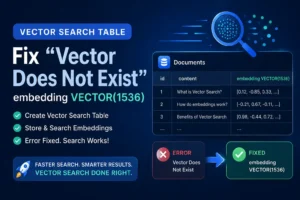
- Create a Vector Search Table & Fix “Vector Does Not Exist” embedding VECTOR(1536)
 ⚡ Quick Answer (TL;DR) Fixing the “vector does not exist” Error This error occurs because the pgvector extension is database-scoped, not server-scoped. Even if pgvector is installed on your server, you must activate it inside your specific target database before Create a Vector Search Table ● Environment Status: Production Ready


Frequently Asked Questions (FAQ)
What is AI Engineering Hub 2026?
AI Engineering Hub 2026 is a practical learning platform focused on building real-world artificial intelligence systems using modern machine learning workflows, retrieval-based architectures, and backend development techniques.
What will I learn in AI Engineering Hub?
You will learn how to design and build production-ready AI applications, including data retrieval systems, embedding-based search, and end-to-end machine learning pipelines used in real software systems.
What are vector databases used for in AI systems?
Vector databases are used to store and retrieve high-dimensional data representations efficiently, enabling similarity search, intelligent retrieval, and modern AI-powered search applications.
What is a retrieval-augmented system?
A retrieval-augmented system combines information search with generative AI models to improve response accuracy by using external knowledge sources during generation.
How is Python used in AI development?
Python is widely used in artificial intelligence for building APIs, processing data, integrating machine learning models, and developing backend systems for AI-powered applications.
Are these AI technologies used in real production systems?
Yes, retrieval systems, embedding-based search, and large language model applications are widely used in production environments across modern AI-driven companies.