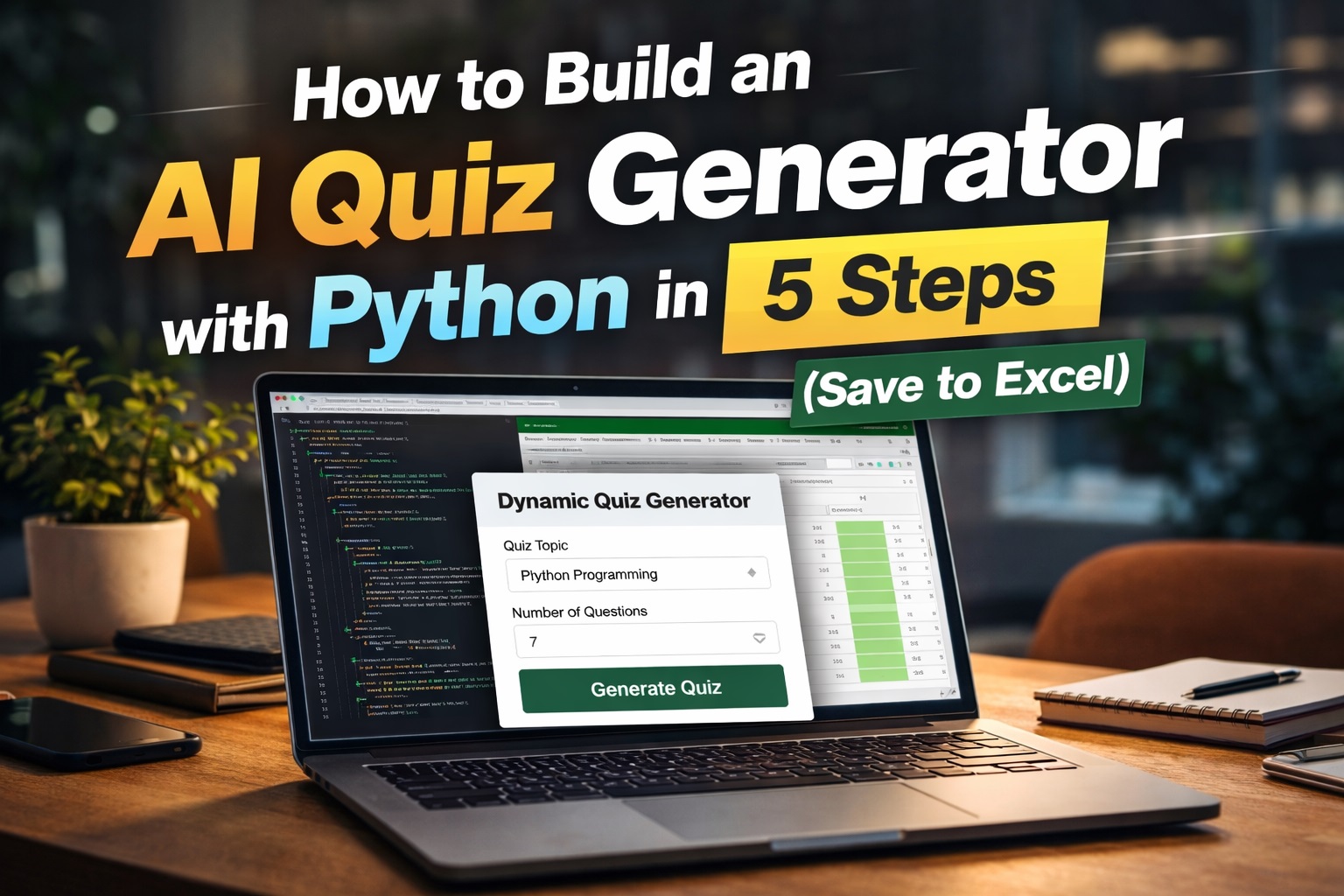
How to Build an AI Quiz Generator with Python in 5 Steps (Save to Excel)
In this tutorial, you’ll learn how to build an AI Quiz Generator with Python in 5 easy steps. This tool uses OpenAI to generate multiple-choice questions automatically and saves them to Excel, making it perfect for interview preparation and learning.
Project Overview
Here’s what the script does:
- Takes user input (topic + number of questions)
- Sends a request to OpenAI
- Generates MCQs in JSON format
- Converts JSON into a DataFrame
- Saves the output as a CSV file
Before we dive in: If you’re interested AI Sql Tool tasks with Python, check out my guide on how to Build an AI that converts English to SQL using Python. It’s a great next step after mastering this quiz generator!
Introduction
As a developer, I’ve always wanted a simple way to generate interview questions or MCQ quizzes without spending hours writing them manually. That’s when I decided to build a small but powerful project — an AI Quiz Generator using Python with OpenAI . If you are interested. Here, is the link without using AI complete coding video in my youtube channel Complete PYTHON Web App Development: Quiz App with User Login!
In this blog post, I’m building an AI tool that automatically creates multiple-choice questions based on any topic and saves them directly into an Excel (CSV) file using python coding. It’s perfect for students, developers, trainers, or anyone preparing interview content.
In this guide, I’ll walk you through how I built it step by step.
Why This Project is Useful
If you’ve ever:
- Prepared interview questions manually
- Created quizzes for students and helpful for mock interview preparations
- Needed quick MCQs for practice
You know how time-consuming it can be.
This tool solves that by:
- Generating questions instantly
- Ensuring structured format (JSON)
- Saving directly into Excel for easy use
📝 Key Takeaways: Project Requirements
| Component | Library / Technology | Purpose |
|---|---|---|
| Language | Python 3.x | Core logic for the quiz script. |
| AI Integration | openai | Connects to the GPT-4o-mini model. |
| Data Structure | json & re | Cleans and parses AI responses. |
| Data Export | pandas | Formats questions into a CSV table. |
| Security | python-dotenv | Protects API keys via .env file. |
| Output File | .csv | Universal format for Excel/Interviews. |
💻 1. Basic Knowledge
Before starting, you should know:
- Python basics (variables, loops, functions)
- Basic understanding of APIs
- Simple file handling (CSV/Excel)
👉 That’s enough — no advanced AI knowledge needed. Code Editor (Any One) Install any editor: Notepad++ (basic), Visual Studio Code (Recommended), PyCharm and MS-Excel , Good Internet Connection
Ok, now its time to dive into a coding part , In this tutorial iam using a Visual Studio Code for coding and Openai (for apikey its not a free apikey) openai charge small amount of fees for apis..
👉 Step 1 OpenAI API Key
Create account : To create account in openai is very easy just login with your valid gmail account.
How to Generate an OpenAI API Key
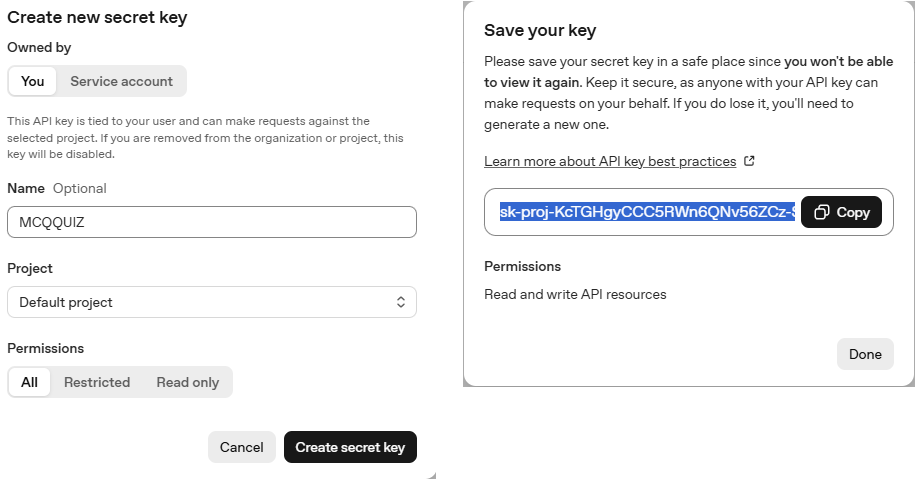
To get started, log in to your OpenAI account. On the left-hand side panel, look for the API keys tab. Clicking this will take you to the API management page.
Follow these steps to generate your key:
- Create the Key: Click the button labeled “Create new secret key.”
- Configure: Give your key a recognizable name and set your preferred permissions.
- Finalize: Click the “Create secret key” (or Add) button.
Important Note: Once the key is generated, a pop-up will appear with your secret key. Copy it immediately and save it in a secure place, like a password manager or a private note. For security reasons, OpenAI will never show you the full key again once you close that window. If you lose it, you’ll have to delete it and create a new one.
Now Coding Part ! Iam using Visual Studio Code
Setting Up Your Project Files
First, we need to create two essential files: .env and Generate_Dynamic_Quiz.py. These should be placed directly in your root directory. In this case, the path is C:\wamp64\www\Algo.
I personally use the Algo folder as my main workspace where I save all of my development projects, so make sure you’re in that specific directory before you begin.
Step 1: Setup .env File
To keep your API key secure, use a .env file: Just add this code in your .env file and replace your openai apikey in “your-api-key-here”
OPENAI_API_KEY="your-api-key-here"This ensures your key is not exposed in the main code.
Step 2: Install Required Libraries
Run this command:
pip install openai pandas python-dotenv
Step 3: Python Code Explanation
Load Environment Variables
load_dotenv(override=True)
client = OpenAI(api_key=os.getenv("OPENAI_API_KEY"))
Step 4: User Input
The program starts by asking you for two pieces of information. This makes the script “dynamic,” meaning you can create a quiz for any topic without changing the code.
Python
topic = input("Enter quiz topic: ")
num_questions = int(input("How many questions? "))
Step 5: AI Prompt Design
This is the most important part.
You used a structured JSON prompt, which is excellent:
- Forces AI to return clean output
- Avoids unnecessary explanations
- Makes parsing easy
Step 6: API Call
response = client.chat.completions.create(
    model="gpt-4o-mini",
    messages=[{"role": "user", "content": prompt}],
    temperature=0.3,
)
Low temperature ensures:
- More accurate answers
- Less randomness
Step 7: JSON Cleaning
cleaned = re.sub(r"```json|```", "", raw_content).strip()
quiz_data = json.loads(cleaned)
This step removes unwanted markdown formatting and converts data into usable JSON.
Step 9: Convert to Excel (CSV)
df.to_csv(file_name, index=False)
Your quiz gets saved like:
create_chatgpt_beginners_interview_questions_quiz.csv

Output Example
Your Excel file will contain:
- Question
- 4 options
- Correct answer
Complete Code, Build an AI Quiz Generator with Python in 5 Easy Steps (Save to Excel)
import json
import re
import pandas as pd
from openai import OpenAI
from dotenv import load_dotenv
import os

load_dotenv(override=True)
client = OpenAI(api_key=os.getenv("OPENAI_API_KEY"))

# ===== USER INPUT =====
topic = input("Enter quiz topic: ")
num_questions = int(input("How many questions? "))

# ===== STRONG JSON PROMPT =====
prompt = f"""
Generate exactly {num_questions} multiple choice questions on the topic: {topic}.

Rules:
- Each question must have 4 options.
- Only 1 correct answer.
- Return ONLY valid JSON.
- Do NOT include explanations.
- Do NOT include markdown.
- Do NOT include text before or after JSON.

Format strictly like this:

[
  {{
    "question": "Question text",
    "option1": "Option A",
    "option2": "Option B",
    "option3": "Option C",
    "option4": "Option D",
    "right_answer": "Correct option text"
  }}
]
"""

try:
    response = client.chat.completions.create(
        model="gpt-4o-mini",
        messages=[{"role": "user", "content": prompt}],
        temperature=0.3,
    )

    raw_content = response.choices[0].message.content.strip()

    # Remove markdown if present
    cleaned = re.sub(r"```json|```", "", raw_content).strip()

    # Convert JSON string to Python list
    quiz_data = json.loads(cleaned)

except json.JSONDecodeError:
    print("\n❌ Error: AI did not return valid JSON.")
    print("Raw Response:\n", raw_content)
    exit()

except Exception as e:
    print("\n❌ Unexpected Error:", str(e))
    exit()

# ===== CREATE DATAFRAME =====
rows = []

for i, item in enumerate(quiz_data, start=1):
    rows.append(
        {
            "q_no": i,
            "question": item.get("question", ""),
            "option1": item.get("option1", ""),
            "option2": item.get("option2", ""),
            "option3": item.get("option3", ""),
            "option4": item.get("option4", ""),
            "right_answer": item.get("right_answer", ""),
        }
    )

df = pd.DataFrame(rows)

# ===== SAVE FILE =====
file_name = f"{topic.replace(' ', '_')}_quiz.csv"
df.to_csv(file_name, index=False)

print(f"\n✅ Quiz saved successfully as {file_name}")
Ready to use for:
- Interviews
- Practice tests
- Educational content
Real-World Use Cases
This project is more powerful than it looks. You can use it for:
- Interview preparation platforms
- EdTech tools
- Blog content generation
- YouTube quiz videos
- Online test systems
🔥 Python AI Engineer – Mock Interview (3 Questions)
✅ 1. How do you integrate an AI model (like OpenAI) into a Python application?
In Python, AI models are integrated using APIs or libraries. For example, using the OpenAI Python SDK, we can send prompts and receive responses.
Steps:
- Install required library
- Load API key securely using
.env - Send request using client
- Process response
2. What is prompt engineering and why is it important?
Prompt engineering is the process of designing input prompts to get accurate and structured responses from AI models.
It is important because:
- AI output depends heavily on input quality
- Structured prompts (like JSON format) improve reliability
- Reduces errors in production systems
Example from your project:
Return ONLY valid JSON with question, options, and correct answer
👉 This ensures:
- Clean output
- Easy parsing
- No extra text
3. How do you handle invalid or unexpected AI responses in Python?
AI responses may sometimes:
- Return invalid JSON
- Include extra text
- Break formatting
To handle this:
Techniques:
- Use
try-exceptfor JSON parsing - Clean response using regex
- Validate keys before processing
Example:
try:
    data = json.loads(response)
except json.JSONDecodeError:
    print("Invalid JSON received")
👉 Best practice:
- Always validate AI output before using it in applications
Conclusion : In this tutorial, we built an AI quiz generator using Python and OpenAI and save into a excel(.csv) file. This project demonstrates how powerful AI can be when combined with simple Python scripts. You can extend this project further by adding a web interface or database storage.