

A Data Engineer AI Interview MCQ Quiz 2026 is a structured set of multiple-choice questions covering SQL, Python, ETL pipelines, cloud platforms, and machine learning concepts essential for current hiring.
These quizzes are AI-curated to mirror real interview patterns at top tech companies like Google, Amazon, and Meta. Each question is mapped to job description keywords, making preparation precise, fast, and role-specific.
Cracking a SQL data engineer interview questions for freshers 2026 felt overwhelming until I started practicing topic-wise MCQs daily — SQL window functions and Spark optimization questions appeared in 3 of my 5 interviews. The quiz format forced me to think under time pressure, which traditional tutorials never replicated. Reviewing wrong answers taught me more than reading documentation for hours.
Important Topics Covered in This Quiz
- SQL (Advanced): Window functions, CTEs, query optimization, indexing strategies
- Python for Data Engineering: Pandas, PySpark, data wrangling, lambda functions
- ETL & ELT Pipelines: Apache Airflow, dbt, batch vs. streaming workflows
- Cloud Data Platforms: AWS Glue, GCP BigQuery, Azure Data Factory
- AI & ML Concepts: Feature engineering, model pipelines, vector databases, LLM APIs
- Data Modeling: Star schema, snowflake schema, medallion architecture
- Real-time Data: Kafka, Flink, event-driven architecture
- Interview Strategy: Time management, eliminating wrong options, pattern recognition
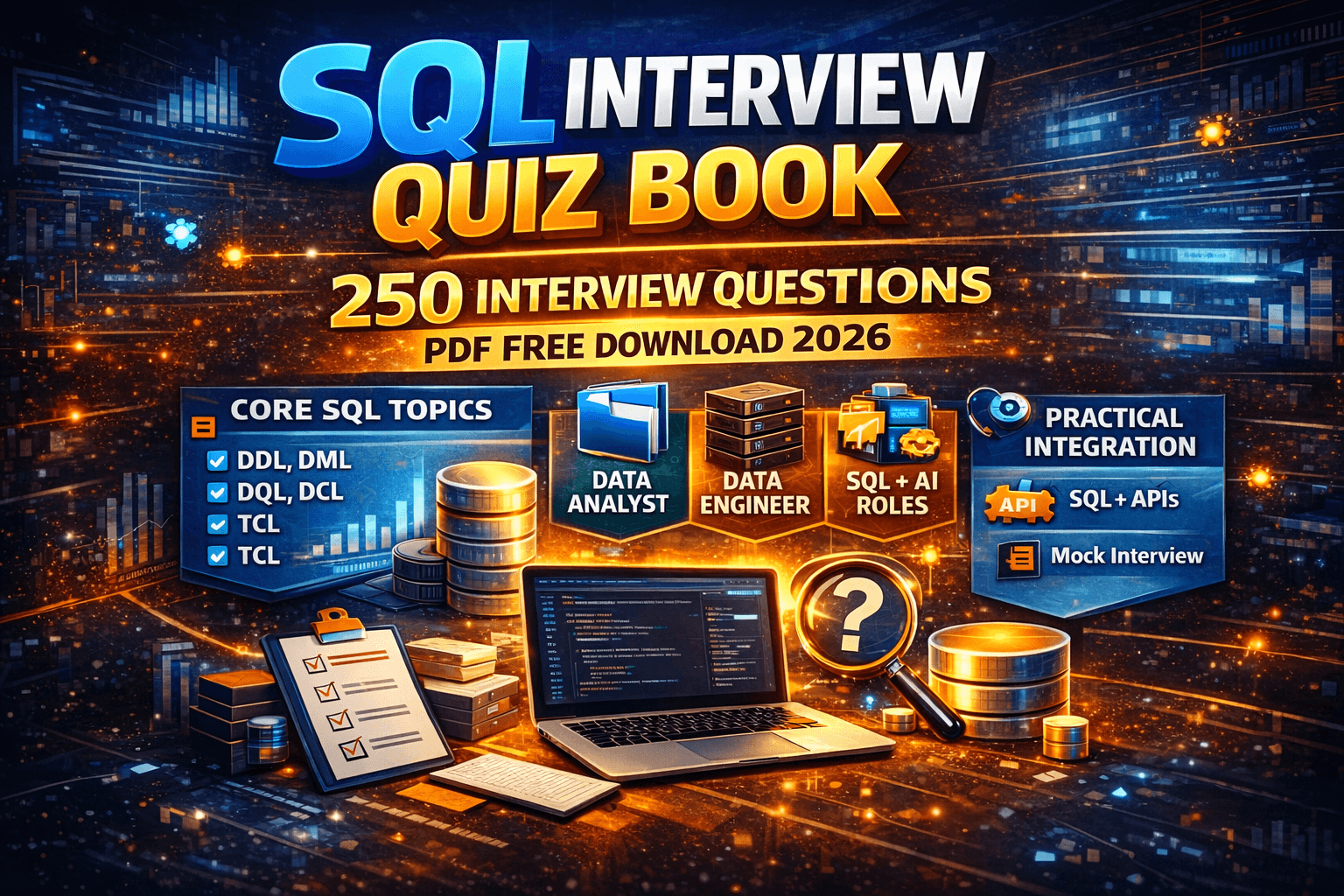
Introduction
When I started preparing for Data Engineer and AI interviews, I realized theory alone wasn’t enough. Interviews require real-time problem-solving, not just memorization.
That’s why I created this quiz — a collection of challenging, scenario-based questions inspired by real interview patterns in SQL, data pipelines, and AI systems.
Designed for AI Data Engineer interview questions for freshers and experienced, this quiz goes beyond basics. It includes advanced concepts like AI API integration with SQL and focuses on real-world, production-level problems.
If you are interested please check Ultimate Python AI Mock Interview Quiz for Python AI Mock Interview
If you can solve these, you’re not just learning — you’re becoming interview-ready.
Quiz SQL AI Data Engineer Interview Questions PDF 2026
🚀 SQL data engineer interview questions for freshers 2026
Test your skills with real-world, scenario-based questions designed for Data Engineers and AI roles.
- 🎯 25 most-asked SQL questions
- 💡 Score 80% to unlock the PDF
- 📊 Test your SQL knowledge and skills
📥 Get 250 Questions PDF
Instant download. No email. 100% free.
- 👉 Instant access
- 👉 No signup required
- 👉 Completely free
Topics AI Data Engineer interview questions for freshers and experienced
In this quiz, I have covered the most important topics based on my experience while preparing for SQL Data Engineer and AI roles. I didn’t just focus on theory — I included practical concepts that companies actually expect in interviews today. These topics will help you improve both your knowledge and your confidence.
Core SQL Commands
From my experience, strong SQL basics are the foundation for any data role. In this section, I have included questions related to DDL, DML, and DQL commands. These are the types of questions I personally faced in interviews and also used in real projects. That’s why I created this SQL and AI Data Engineer interview questions PDF free download (2026) — to help both freshers and experienced candidates prepare in a practical way.
Here is an real tutorial how when AI intergrated with sql database without writing a single line of code 5 Easy Steps to Quickly Create a Table in PostgreSQL Using Python with pgAdmin 4
If you are adding skills to your resume, make sure you are confident in writing queries like SELECT, INSERT, UPDATE, DELETE, and working with constraints. Interviewers always check how strong your basics are, especially for AI Data Engineer interview questions for freshers and experienced candidates.
When I first started learning SQL, I honestly thought these core statements — DDL, DML, DQL, DCL, and TCL — were just basic topics that I could quickly go through. But when I started attending interviews, I realized this was a big mistake.
Most people fail in SQL interviews not because they don’t know advanced concepts, but because they are not strong in these basics. This is something I’ve noticed repeatedly while preparing for AI Data Engineer job interview questions, where even simple SQL tasks become challenging without a strong foundation.
From my experience and knowledge, interviewers don’t directly ask “What is DDL?” Instead, they give practical tasks like:
- Create a table with constraints like primary key (postgresql)
- Update records based on a condition
- Write a query to fetch specific data
- Handle transactions or rollbacks
If your basics are not clear, you will struggle even with simple questions.
DDL (Data Definition Language) helped me understand how to design tables properly — like using primary keys, constraints, and structure. Without this, your database design becomes weak.
DML (Data Manipulation Language) is something I use every day. Insert, update, and delete operations sound simple, but in real scenarios, one wrong query can affect thousands of records.
DQL (Data Query Language) is where most interviews focus. Writing SELECT queries is easy, but writing optimized queries with conditions, joins, and filters is what really matters — especially in AI Data Engineer interview scenarios.
DCL (Data Control Language) and TCL (Transaction Control Language) are often ignored by beginners. I used to skip them too. But in real-world projects, managing access (GRANT, REVOKE) and handling transactions (COMMIT, ROLLBACK) is very important, especially when working with live data systems.
In my experience, once I became strong in these core concepts, everything else — advanced SQL, data engineering workflows, and even AI integration — became much easier.
If you are preparing for SQL data engineer interview questions for freshers 2026, don’t ignore these basics. Most candidates do, and that’s exactly where they lose opportunities.
Advanced SQL Concepts
Once I became comfortable with basics, I realized interviews focus more on advanced SQL. That’s why I added topics like JOINs, window functions, CTEs, and query optimization.
In my knowledge, these concepts are very important for real-time work. If you want to stand out, you should be able to solve scenario-based problems using these techniques. Also, adding “Advanced SQL” and “Query Optimization” to your resume really increases your chances.
Once I became comfortable with SQL basics, I realized that most interviews focus more on advanced SQL concepts. That’s why I included topics like JOINs, window functions, CTEs, and query optimization in this SQL and AI Data Engineer interview questions PDF free download (2026).
From my experience, interviewers don’t usually ask direct theory questions. Instead, they focus on real-time, scenario-based SQL interview questions, especially for AI Data Engineer interview questions for freshers and experienced candidates.
Window Functions & Aggregate Functions
In many interviews, I’ve faced questions like:
- “Find the second highest salary”
- “Get the top 3 records from each department”
These are very common advanced SQL interview questions. At first, I tried solving them using basic queries, but it became complex. That’s when I started using window functions like ROW_NUMBER(), RANK(), and DENSE_RANK().
In real-world projects, I’ve used these to calculate rankings, running totals, and comparisons — which are very important for data engineering and analytics roles.
SQL JOIN Interview Questions
JOINs are one of the most important topics in SQL interview questions for Data Engineers.
In my interviews, I was asked real-world questions like:
- “Get customer details with their orders”
- “Find customers who never placed an order”
These types of scenario-based SQL interview questions test your understanding of INNER JOIN, LEFT JOIN, and other joins. From my experience, knowing syntax is not enough — you should know when to use each JOIN.
CTE (Common Table Expressions) Interview Questions
While preparing for AI Data Engineer job interview questions, I once wrote a long query using subqueries. The interviewer asked me to simplify it.
That’s when I learned about CTEs.
CTEs are very useful in advanced SQL concepts interview questions because they:
- Make queries more readable
- Help break down complex logic
- Improve debugging
Now I always use CTEs in real-time SQL problems, especially when dealing with large datasets.
Optimization & Advanced SQL Techniques
This is one of the most important areas in SQL optimization interview questions for experienced candidates.
In one interview, I wrote a correct query, but the interviewer asked:
“Can you optimize this query?”
That’s when I realized companies expect more than correct answers — they expect efficient and scalable solutions.
From my experience, optimization includes:
- Writing efficient queries
- Using proper indexing
- Avoiding unnecessary data retrieval
- Understanding execution plans
These skills are very important for Data Engineer interview questions and real-world applications.
💡 Final Thought
Advanced SQL is not just about learning functions — it’s about solving real problems efficiently.
If you practice these SQL and AI interview questions, especially scenario-based ones, you’ll gain real confidence. And in my experience, that’s exactly what interviewers look for.
SQL + API Integration
This is something I learned recently while working on modern applications. Today, it’s not enough to only know SQL — you should also understand how data flows between APIs and databases.
Based on my experience, many companies are now expecting knowledge of API integration along with SQL. That’s why I included questions related to AI API usage, fetching data, and storing it in databases. This is a powerful skill you can highlight in your resume as “SQL + API Integration” and some Big AI Companies providing api keys like gemini ai studio
How AI is Changing Database Concepts
From what I’ve seen in recent projects, AI is changing the way we work with databases. Earlier, we used SQL mainly for storing and retrieving data. But now, with AI integration, databases are becoming smarter and more powerful.
Today, it’s not just about writing SQL queries — it’s about combining SQL with AI to:
- Analyze large datasets quickly
- Generate insights automatically
- Build intelligent, data-driven applications
In real-time projects, I’ve seen developers use AI APIs to:
- Process unstructured data like text or logs
- Generate summaries from database records
- Automate data analysis tasks
Real-Time Use in Jobs
In real job scenarios, this combination is very useful.
For example, a typical workflow looks like this:
- Fetch data using SQL
- Send it to an AI API for processing
- Store the processed results back in the database
This kind of workflow is becoming very common in AI and Data Engineering roles.
From my experience, companies are not just looking for someone who can write SQL queries — they want someone who can build complete data solutions.
Why SQL Alone is Not Enough in 2026
In 2026, just knowing SQL syntax is not enough.
Many candidates can write queries, but they struggle when it comes to:
- Handling real-time data
- Integrating external systems
- Building scalable solutions
That’s where AI concepts come in.
If you understand:
- API integration
- Data pipelines
- AI-based data processing
you automatically stand out from other candidates.
💡 Final Thought
From my learning journey, I can say this — SQL is still the foundation, but AI is the layer that adds real power.
That’s why in my blog, I focus on database concepts with AI integration, so you can learn not just theory, but practical skills that are actually useful in real jobs.
Mock SQL Interview (Live Scenario)
In my preparation journey, I’ve attempted many mock interviews, and they helped me the most. They made me realize how to think under pressure and solve problems quickly.
This section is designed based on real interview scenarios I have seen. You will face practical questions where you need to apply your knowledge, not just remember answers. If you can solve these, you are already closer to being interview-ready.
Conclusion
Preparing for Data Engineer and AI roles in 2026 is no longer just about knowing SQL syntax — it’s about understanding how to apply that knowledge in real-world scenarios. Throughout this guide, we’ve covered not only core SQL fundamentals but also advanced concepts, optimization techniques, and the growing importance of integrating SQL with modern AI workflows.
From my experience, the biggest difference between an average candidate and a job-ready professional is the ability to think practically. Interviews today are designed to test how you approach problems, optimize solutions, and work with real data — not how well you memorize definitions.
This is exactly why this collection of 250 SQL and AI Data Engineer interview questions focuses on scenario-based learning. If you take the time to solve these questions, understand the logic behind them, and practice consistently, you’ll build the confidence needed to handle real interview challenges.
Also, as the industry evolves, combining SQL with API integration and AI-based data processing is becoming a key skill. Companies are looking for engineers who can go beyond queries and build complete, scalable data solutions.
So don’t just read through the questions —
👉 Practice them
👉 Experiment with different approaches
👉 Think like a problem solver
If you do that, you won’t just be preparing for interviews — you’ll be preparing for real-world Data Engineering and AI roles.
🚀 Keep learning, keep building, and stay consistent — that’s what truly makes you stand out.
F.A.Q – SQL & AI Data Engineer Interview Questions (2026)
1. Are these SQL and AI interview questions suitable for beginners?
Yes. This collection is designed for both freshers and experienced candidates. If you are a beginner, start with core SQL concepts like SELECT, JOINs, and basic queries, then gradually move to advanced topics like window functions and optimization.
2. Do I need to know programming before learning SQL for Data Engineering?
Not necessarily. You can start with SQL alone. However, having basic knowledge of Python or any programming language will help you understand data pipelines, automation, and AI integration much faster.
3. What is the difference between Data Engineer and AI Engineer roles?
A Data Engineer focuses on building data pipelines, managing databases, and ensuring data availability.
An AI Engineer works on building models, integrating AI APIs, and creating intelligent systems.
In modern roles, these skills often overlap — especially when working with SQL + AI integration.
4. How important is SQL for AI and Data Engineering interviews?
SQL is one of the most important skills. Almost every Data Engineer interview includes SQL-based questions. Even in AI roles, SQL is used for data extraction, preprocessing, and analysis.
5. Are advanced SQL topics really asked in interviews?
Yes. Most companies focus on:
- JOINs
- Window functions (ROW_NUMBER, RANK)
- CTEs
- Query optimization
These are commonly asked in real-time, scenario-based interviews.
6. What kind of questions are included in this PDF?
This PDF includes:
- Core SQL questions
- Advanced SQL scenarios
- Real-world problem-solving questions
- SQL + API integration concepts
- Mock interview questions
The goal is to simulate actual interview patterns, not just theory.
7. How can I use this quiz effectively?
To get the best results:
- Try solving questions without looking at answers
- Practice writing queries manually
- Focus on understanding logic, not memorization
- Revisit difficult questions multiple times
Consistency is key.
8. Is SQL alone enough to crack Data Engineer interviews in 2026?
No. SQL is the foundation, but companies now expect knowledge of:
- Data pipelines
- API integration
- Basic AI concepts
- Real-time data processing
Combining these skills will give you a strong advantage.
9. How long does it take to prepare using these questions?
If you practice daily:
- Beginners: 4–6 weeks
- Intermediate: 2–3 weeks
It depends on your consistency and how deeply you understand each concept and this my youtube channel Real Time scenario PostgreSQL Database With AI Integration Playlist 2026
10. Is the PDF really free? Do I need to sign up?
Yes, the PDF is completely free.
There is no signup required — you can unlock it instantly by completing the quiz.
11. Can I use these questions for real interview preparation?
Absolutely. These questions are designed based on:
- Real interview experiences
- Common industry patterns
- Practical, scenario-based problems
They will help you become interview-ready, not just theoretically strong.
12. What should I do after completing this quiz?
After completing the quiz:
- Practice advanced SQL problems
- Work on real-world projects
- Build small data pipelines
- Explore AI API integrations
This will help you move from learner → job-ready professional.
💡 Final Tip:
Don’t just aim to complete the questions — aim to master the concepts behind them. That’s what truly makes a difference in interviews.