Can AI Replace Java & C# Developers? The Honest Reality in 2026

Will AI replace developers in 2026? This is one of the most talked-about and confusing questions in today’s tech world.
From my experience, AI is not replacing developers — it’s transforming how we work. Tools are getting smarter, coding is becoming faster, but real development still depends on human thinking and problem-solving. here is Free AI Coding Tools for Developers 2026 – Top 10+ Must Try
In this post, I’ll share the honest reality and what it means for your future as a developer.
If you have basic knowledge of coding, you might have noticed that traditional coding has changed a lot. Today, we need to use AI in our development process to make our work faster and more efficient.
You can also check out my latest blog posts on AI with Python coding and real-time tutorials.
Will AI Replace Java Developers in 2026?
Is Java Still Relevant in 2026? From my experience working with backend technologies, Java is still one of the strongest languages in enterprise development. AI tools today can generate code, suggest improvements, and even fix small bugs, but they cannot fully replace Java developers.
AI is very good at generating code quickly, especially for simple tasks. But when real errors happen, debugging complex issues still requires a developer’s thinking and experience. In many cases, AI-generated code also needs proper validation and optimization, which only an experienced developer can handle.
Most real-world Java applications involve complex systems like banking, large-scale APIs, and enterprise architectures. These require deep understanding, system design skills, and business logic — something AI still struggles with. While AI can handle small web designs or basic applications, it is not reliable enough for high-risk systems like banking or security-related applications.
AI can help Java developers become more productive, but it cannot take full ownership of building and maintaining large systems. So, instead of replacing Java developers, AI is actually becoming a powerful assistant to the programmers.
In my opinion, Java developers who learn how to use AI tools in coding will have a huge advantage in 2026 and beyond.
Will AI Replace C# Developers in 2026?
I’ve noticed that using AI tools in daily development, I can clearly say that AI is powerful — but it has limits.
AI is very good at:
- Generating code quickly
- Writing simple functions
- Creating basic web designs
- Suggesting fixes for small errors
But when it comes to real development, things are different. C# is not just about writing code — it’s part of a larger ecosystem. With the Microsoft stack, developers work on enterprise applications, desktop software, and cloud-based solutions using Azure. These systems are not simple projects; they require deep understanding, architecture planning, and long-term maintenance.
AI cannot fully understand business logic, user requirements, or long-term system design. It works based on patterns and data, not real-world thinking. That’s why sometimes AI-generated code looks correct but fails in real scenarios.
For example, if you ask AI to build a simple CRUD application, it can do it easily. But if the project involves security, scalability, or complex workflows, AI alone is not enough.
Another important point is debugging. AI can suggest solutions, but when a complex issue occurs, only a developer can analyze the root cause and fix it properly.
In my opinion, AI is like a smart assistant — not a replacement. It can speed up development, but it still needs a developer to guide it. So, no chance Will AI replace C# developers
If you’re interested in learning C# and ASP.NET MVC, I’ve created a complete playlist on my YouTube channel. This will help you understand real-time development concepts step by step:
My Experience: Will AI replace developers in 2026?
From what I’ve observed, AI has already started changing the way I work as a developer. A few years ago, I used to spend a lot of time writing basic code, searching for syntax, and fixing small issues manually. Now, with AI tools, many of these tasks are much faster. Here is a real tutorial blog post No SQL Query Create Tables from English Using AI Generate Postgres
For example, when I’m building a small feature or writing a function, AI can generate a starting point within seconds. This saves time and helps me focus more on the logic instead of typing everything from scratch. It feels like having a smart assistant sitting next to me.
One real example from my work is using Python with AI APIs. I’ve connected AI tools using API keys and worked on projects where I convert plain English into SQL queries. Instead of writing complex SQL manually, I can give a simple input like “get top 5 customers by sales,” and the AI generates the query. This saves a lot of time, especially when working with databases.
But even in this case, I’ve noticed that AI is not always perfect. Sometimes the generated SQL query has mistakes or doesn’t match the exact database structure. I still need to review the query, adjust joins, and optimize it based on real data. This is where developer knowledge becomes very important.
Another big change I’ve seen is in debugging. AI can suggest possible fixes, but it cannot fully understand the root cause of complex issues. I still need to analyze the problem, check logs, and think through the solution step by step.
In my day-to-day work, I now use AI more as a productivity tool rather than depending on it completely. It helps me move faster, but I never trust it blindly. I always review, test, and optimize the code before using it. Another Good tutorial How to Build an AI Quiz Generator with Python in 5 Steps (Save to Excel)
From what I’ve learned so far, AI is not replacing development — it’s reshaping it. Developers who adapt to these tools will save time and work more efficiently, while those who ignore them may struggle to keep up.
In my opinion, the real advantage in 2026 will not be about who knows more code, but who knows how to use AI effectively along with strong development skills.
AI vs Developers
| Task | AI Tools | Developers |
|---|---|---|
| Code Generation | Generates code quickly for simple tasks | Writes optimized and context-aware code |
| Debugging | Suggests possible fixes but misses root causes | Identifies and solves complex issues accurately |
| System Design | Limited understanding of architecture | Designs scalable and maintainable systems |
| Business Logic | Works on patterns, lacks real understanding | Understands real-world requirements |
| Performance | Basic optimization suggestions | Optimizes based on real data and usage |
| Security | May overlook edge cases | Applies secure coding practices |
| Decision Making | Cannot take responsibility | Makes informed decisions |
| Adaptability | Limited to training patterns | Adapts to changing requirements |
From my experience using AI tools in daily development, I can clearly say that AI is powerful — but it has limits.
AI is very good at:
- Generating code quickly
- Writing simple functions
- Creating basic web designs
- Suggesting fixes for small errors
But when it comes to real development, things are different.
AI cannot fully understand business logic, user requirements, or long-term system design. It works based on patterns and data, not real-world thinking. That’s why sometimes AI-generated code looks correct but fails in real scenarios.
For example, if you ask AI to build a simple CRUD application, it can do it easily. But if the project involves security, scalability, or complex workflows, AI alone is not enough.
Another important point is debugging. AI can suggest solutions, but when a complex issue occurs, only a developer can analyze the root cause and fix it properly.
In my opinion, AI is like a smart assistant — not a replacement. It can speed up development, but it still needs a developer to guide it.
Why AI Cannot Replace Real Developers
One thing I’ve observed is that many people misunderstand the question: will AI replace developers in 2026? In reality, development is far more than just writing code.
Developers do much more than type syntax — we gather requirements, talk to clients, design systems, optimize performance, and handle unexpected issues. AI cannot truly grasp these aspects; it only predicts based on existing data.
Here’s why that matters:
- AI can generate code quickly, but it doesn’t fully understand business logic or system architecture.
- Sometimes AI-generated code looks correct, yet fails in real-world scenarios involving security, scalability, or complex workflows.
- Human developers are still needed to validate, debug, and apply real-world reasoning.
Another major limitation is adaptability. Each project is unique — requirements change, bugs behave differently, and systems evolve. AI cannot adjust in the way a developer with hands-on experience can.
Critical decision-making is another area where AI falls short. For example, in banking or security applications, even a small mistake can have serious consequences. Human judgment remains essential.
From what I’ve seen, AI is best treated as a tool — a powerful assistant, but not a replacement. It can speed up repetitive tasks and support development, but the thinking, creativity, and responsibility that developers bring cannot be automated.
Future of Developers 2026
Most developers have one question in mind: Will AI replace developers in 2026? From what I’ve observed and experienced, the role of developers isn’t going away — it’s evolving.
As we move into 2026 and beyond, developers who stick only to basic coding skills might find it harder to keep up. On the other hand, those who embrace new technologies, especially AI, will find even more opportunities opening up.
Technologies like Java and C# continue to power many enterprise systems, and companies aren’t going to rebuild everything just because AI has entered the picture. Instead, they’re finding ways to integrate AI into their existing processes to boost productivity.
There’s also a noticeable shift in expectations. Companies now want developers to work smarter rather than just put in more hours. This includes using AI tools to speed up development, automate repetitive tasks, and improve overall efficiency.
So it’s not really “AI versus developers.” It’s more about developers working alongside AI.
In the coming years, the developers who stand out will be the ones who combine solid programming skills with a good understanding of AI.
Top Skills Developers Must Learn in 2026
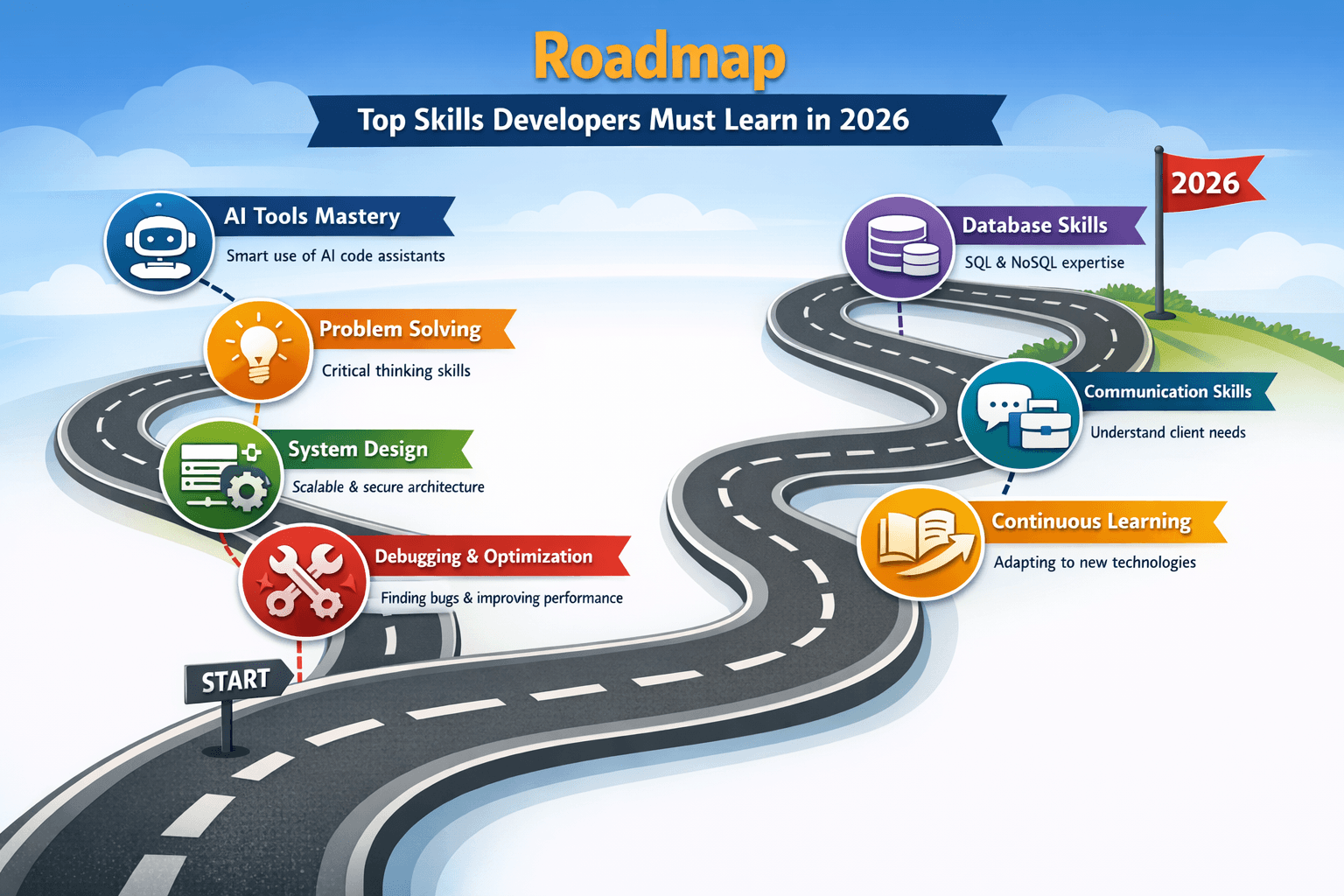
From what I’ve seen in the last few years, the biggest change in development is not about losing jobs — it’s about upgrading skills. The way we write code, build applications, and solve problems is changing fast.
These are the 7 Skills Developers Need in 2026.
- Understanding AI Tools
From my experience, this is no longer optional. Tools like AI code assistants can save a lot of time, but only if you know how to use them properly. It’s not about depending on AI — it’s about using it smartly. - Strong Problem-Solving Skills
AI can generate code, but it cannot truly understand real-world problems. As developers, our main job is not just coding — it’s solving problems. This skill will always be valuable. - System Design and Architecture
In real projects, writing code is just one part. Designing scalable, secure, and efficient systems is much more important. This is where experienced developers stand out. - Debugging and Optimization
In my day-to-day work, debugging takes more time than writing code. AI can suggest fixes, but finding the root cause of an issue still requires human thinking. Performance optimization is also a key skill. - Understanding Databases and Data
Whether it’s SQL or NoSQL, every application depends on data. Knowing how to design tables, write efficient queries, and handle real data is a must-have skill. - Communication and Business Understanding
This is something many developers ignore. Understanding what the client actually needs is just as important as writing code. Good communication can save hours of unnecessary work. - Continuous Learning Mindset
Technology keeps changing. From my experience, the developers who grow the fastest are the ones who keep learning and adapting.
In my opinion, developers who focus on these skills will not only stay relevant in 2026 but will also grow faster in their careers. AI is not here to replace you — it’s here to work with you. The better you adapt, the better your future will be.
Final Verdict: Should You Be Worried?
From my experience, the fear that AI will completely replace developers is not true — at least not in the way many people think.
AI is definitely powerful. It can generate code, automate tasks, and speed up development. But when it comes to real-world applications like banking systems, secure platforms, and large-scale enterprise projects, human developers are still essential.
AI does not truly understand business logic, user requirements, or system architecture. It can assist, but it cannot take full responsibility. And when things break — which they always do in real projects — it’s the developer who has to step in, understand the problem, and fix it.
In my opinion, the real risk is not AI replacing developers, but developers who don’t adapt to AI tools. The industry is changing, and those who learn how to use AI effectively will have a huge advantage.
So, should you be worried? No. But you should be prepared.
Learn AI tools, strengthen your core skills, and keep improving. If you do that, AI will not replace you — it will work with you and make you a better developer.
Frequently Asked Questions (FAQ)
1. Will AI replace Java developers in 2026?
From my experience, AI will not replace Java developers. It can assist in writing code, but real-world applications require human understanding, system design, and problem-solving skills.
2. Will AI replace C# developers?
No, AI cannot fully replace C# developers. It can automate small tasks, but building secure and scalable applications still requires developer expertise.
3. Is Java still relevant in 2026?
Yes, Java is still widely used in enterprise applications like banking systems and large-scale platforms. It remains one of the most reliable languages.
4. Can AI generate SQL queries automatically?
Yes, AI can generate SQL queries from natural language. However, from my experience, developers still need to review and optimize the queries for real-world use.
5. What skills should developers learn in 2026?
Developers should focus on AI tools, problem-solving, system design, databases, and continuous learning to stay relevant in the industry.
6. Why can’t AI replace developers in 2026?
AI cannot replace developers because it does not truly understand business logic, system design, or real-world requirements. While AI can generate code and assist with small tasks, it still depends on developers to validate, debug, and make decisions. In complex systems like banking, security, and enterprise applications, human thinking and experience are essential.